



By Tanner Stening
News at Northeastern
The COVID-19 pandemic has prompted executives of businesses big and small to rethink their strategies for hiring and retaining employees, recognizing that the so-called “war for talent” has taken on new dimensions amid the shift toward remote and hybrid work, a new Northeastern University survey finds.
More than 1,000 C-suite executives surveyed said that, as a result of the pandemic, they are now more likely to invest in artificial intelligence, leverage remote work as a strategy to recruit new workers, and direct resources toward “upskilling” and training their employees, according to the survey published last month.

Sean R. Gallagher, founder and executive director of the Center for the Future of Higher Education and Talent Strategy at Northeastern. Photo by Matthew Modoono/Northeastern University
Respondents represented a wide national sample of the U.S. economy, across all industries and organizational sizes. The study was conducted by Northeastern’s Center for the Future of Higher Education and Talent Strategy, a university research entity that focuses on the intersection between postsecondary education institutions and employers.
“What’s really unique here are the shifts in behaviors, attitudes, preferences, and strategies of companies from all demographics,” says Sean R. Gallagher, founder and executive director of the Center.
The business leaders also say the pandemic has only accelerated the digitalization of the economy, with the integration of AI, automation, and other technological advancements reshaping the workplace, including the types of skills employers seek from workers.
The survey’s findings in many ways reaffirm pre-pandemic trends in the broader economy, such as increasing automation and the acceleration of AI, while forecasting new ones. For example, business leaders now overwhelmingly value so-called “soft skills”—abilities such as teamwork, critical thinking, and communication—ahead of quantifiable and technical “hard skills” when making hiring decisions, according to the survey.
Northeastern researchers have, in partnership with Gallup Inc., been analyzing and reporting on the impacts of AI and the future of work in prior surveys of business executives and the broader public. Those surveys include Facing the Future (2019), Optimism and Anxiety: Views on the Impact of Artificial Intelligence and Higher Education’s Response (2018), and Innovation Imperative: Enhancing the Talent Pipeline (2014).
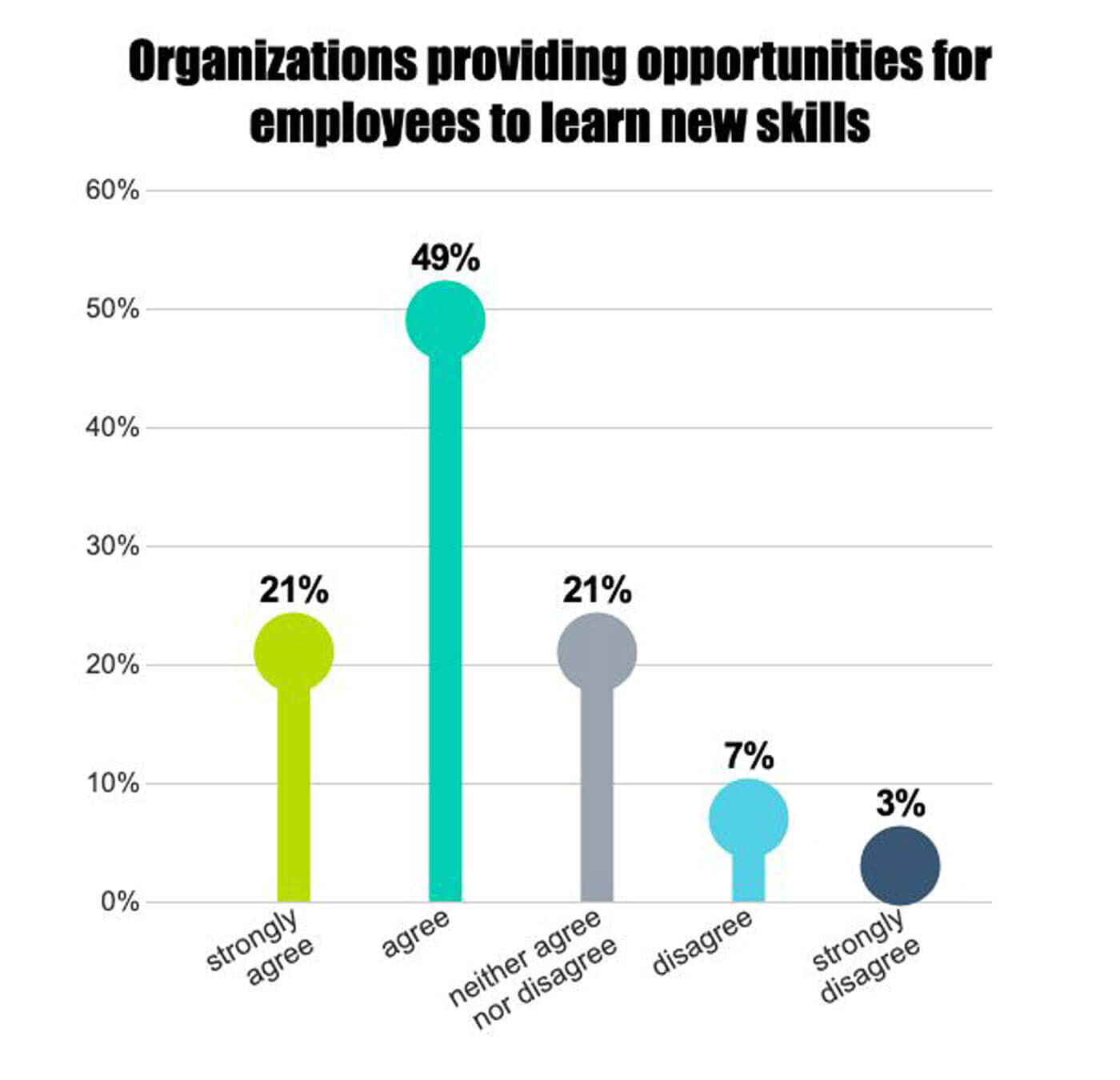

These shifts, and others, are a result of how pandemic disruptions have, on the whole, reordered company priorities, Gallagher says.
“Prior to the pandemic, there was less of an investment in and retaining employees,” Gallagher says. “Now, it appears that’s a top priority” for companies moving forward.
The national survey gives rare insight into the thinking of business leaders during a time of considerable uncertainty, as the country continues to recover from a pandemic-induced recession while now contending with a rise in omicron cases that has again shifted many operations online for the time being.
Remote work also was covered extensively in the survey. Roughly 62% of executives said that following pandemic disruptions, they are “now more likely to leverage remote working arrangements” to expand their talent pool compared to pre-pandemic times. Fifty-two percent predict that “hiring employees who primarily work remotely will be central to their employee talent recruitment and strategy going forward.”
But executives also expressed concern about how remote work affects productivity, specifically the “workforce’s ability to be creative and innovative in a primarily remote work environment.”
About 27% of executives surveyed oversee businesses with fewer than 50 employees, while about 51% run companies that employ between 100 and 5,000 workers. About 9% of respondents run companies that have between 50 and 99 employees; 6% run companies of between 5,000 to 9,999 employees; and roughly 6% represent businesses with more than 10,000 employees. Northeastern researchers queried senior executives ranging from company chairs, CEOs, presidents, and CFOs, among numerous other top positions.
(Reprinted with permission from the News at Northeastern.)