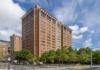



BOSTON — Alexandria Real Estate Equities, Inc., one of the largest life sciences landlords in Greater Boston and a dominant national REIT in the sector, announced that it will cut its quarterly cash dividend by 45%, citing a need to strengthen its balance sheet amid ongoing headwinds in the life sciences and biotech real estate market.
The company declared a fourth-quarter 2025 dividend of $0.72 per common share, down from $1.32 in the previous quarter. The reduction is expected to preserve roughly $410 million in annual liquidity, according to the company.
Alexandria’s dividend cut is one of the sharpest in its 30-year history and comes at a time when vacancy rates in major biotech hubs—including Cambridge, Boston, and the wider Route 128 corridor—have risen to levels not seen in nearly a decade. Industry analysts say the move reflects both company-specific caution and the broader slowdown facing the life sciences sector.
A Sign of Softness in a Once-Red-Hot Market
After nearly a decade of rapid expansion, the life sciences real estate market has cooled significantly since late 2022. Venture funding for biotech startups has moderated, larger pharmaceutical companies have delayed pipeline investments, and tenant demand for new lab space has softened.
The Greater Boston region—home to the largest concentration of life sciences facilities in the U.S.—has seen several projects paused or repriced in recent quarters. Alexandria, with millions of square feet across Kendall Square, Seaport, and Route 128, sits at the center of that shift.
Although the company highlighted that the revised dividend still provides an attractive 5.4% yield (based on its December 1 stock price), the decision indicates Alexandria is prioritizing cash preservation as leasing cycles lengthen and capital markets remain tight.
Reinforcing Financial Flexibility
In its announcement, the REIT said the dividend reduction reflects a long-term strategy to “fortify its already strong balance sheet,” enhance financial flexibility, and ensure it can navigate prolonged uncertainty in capital markets.
Industry observers note that lowering the dividend also gives Alexandria more room to manage debt, maintain its development pipeline selectively, and avoid accessing high-cost capital.
Founded in 1994, Alexandria is widely credited with creating the modern life sciences real estate model and remains the largest operator of life sciences campuses in the nation. Its portfolio spans major research clusters in Greater Boston, San Francisco, San Diego, Seattle, Maryland, Research Triangle, and New York City.
But even for the sector’s most established player, the market reset is forcing adjustments. The dividend cut signals that even top-tier landlords are bracing for a slower recovery as biotech funding, tenant expansions, and construction financing continue to recalibrate.
Analysts expect that the life sciences market will eventually rebound, but the timing remains uncertain. Many anticipate that demand will return unevenly, favoring fully built-out, centrally located lab spaces over new development.
For now, Alexandria’s move underscores the reality that the rapid, capital-intensive expansion that characterized the sector from 2018 to 2021 has given way to a period of consolidation—and caution.